Why is Google Maps an Issue in Healthcare?
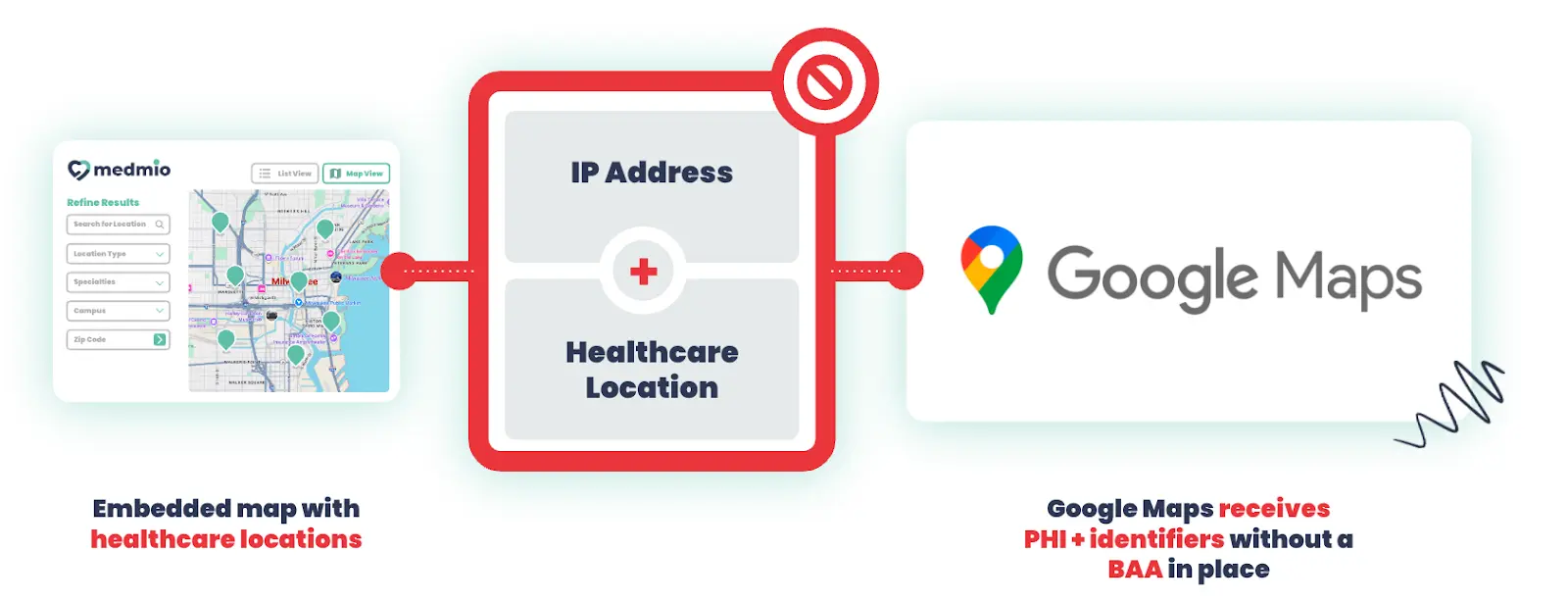
Many healthcare providers embed Google Maps to show where their clinics are. These maps send a whole lot of identifiable information straight to Google. We're talking about details that pinpoint a visitor's location and identity. Some of this data includes:
- IP Addresses
- Cookies
- Device IDs
- Location Information
- Email (If User is Logged into Google)
According to the HHS, many of these identifiers, including IP addresses, are considered protected health information. Here's where it gets risky. Patients use these maps to find clinics based on specialties that might just give away a health condition. It could be as simple as someone searching for "anxiety treatment" at their local hospital’s website. That search signals a potential health condition.
Those user identifiers get linked with potential health conditions. Under HIPAA, healthcare providers must have a Business Associate Agreement (BAA) with any third party that handles Protected Health Information (PHI). But Google? They won't sign BAAs for consumer products like Google Maps. So, if a user identifier and a health condition are transmitted together, you've got a HIPAA violation on your hands.
Why Do Healthcare Providers Use Google Maps?
Despite the privacy issues, Google Maps offers numerous benefits for healthcare providers, including enhanced online searchability and improved patient experience.
Google Maps is crucial for local SEO, and keeping your listing well-optimized is vital for ranking in searches like “doctor near me” or “cardiology appointments near me.” Optimizing a Google Maps listing can be more cost-effective than paid advertising or other marketing channels for generating patient leads. Implementing an entirely new mapping solution means that clinics may have to do duplicate, manual work when adding or updating locations in different mapping tools.
In terms of administering multiple locations, Google Maps is a central way to make sure information across locations is consistent. Alternative map solutions don’t guarantee as easy an experience.
Let’s face it, Google Maps is also incredibly user-friendly. It provides all the information patients need in one place, eliminating the need for additional configuration to enhance the user experience. We’re talking travel times, directions, transportation modes, traffic patterns, and more. Convenience is a significant factor in how patients choose a clinic, and Google Maps' convenience helps.
Can Healthcare Providers Use Google Maps?
The simple answer is yes, but there are caveats. It needs to be configured correctly.
Think about the patient in the example above who was looking for mental health treatment. The issue with the embedded map was not necessarily just the IP Address that helps Google Maps determine the user's location. The problem was that healthcare conditions were transferred to Google along with the IP address.
That means Google Maps can be used for geocoding, directions, and map tiles, if healthcare details in the clinic information are not paired with a user identifier.
Third-party tools (such as Destinations Maps) prevent this combined health information from getting sent to Google. These tools are not necessarily a replacement for Google Maps. Instead, they allow providers to get many of the benefits of Google Maps we mentioned above, but use it in a HIPAA-compliant way.
It looks like this. Noticed that the IP Address is being redacted in a secure, server-side container in the middle step. This ensures that data is not being sent directly from the patient to Google Maps.

Learn More
Ready for HIPAA Compliant Maps?
Learn more about how the Destinations platform makes third-party trackers HIPAA compliant.
Learn More →