Many CMOs and marketing leaders like you are hitting this wall. But your day-to-day realities are all different. Some are dealing with no CRM, no central data repository, and no way to tie a dollar of marketing spend to booked appointments, let alone attended appointments. That reality is even worse if you came from a consumer marketing background. Performance marketing is so much more straightforward there. Healthcare can feel so siloed, and incredibly resistant to marketing as a growth driver. Here's a visual that shows the stark difference:
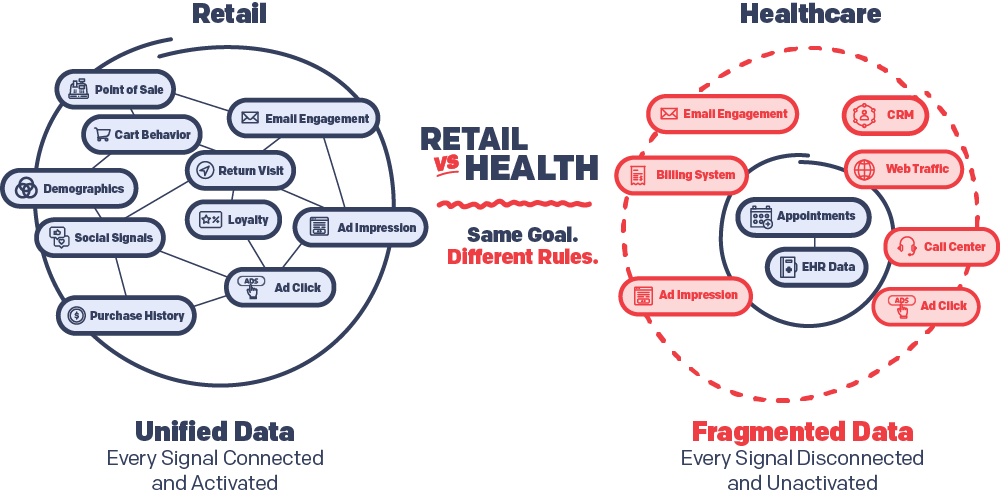
But we're seeing a shift thanks to a focus on connecting data.
The Challenge: You Have an Activation Problem
Healthcare generates roughly 30% of the world's data. About 80% of it goes unused. Health orgs want to use it. The problem is it's trapped. Every team works from a piece of the patient story, and disjointed data produces bad results. That's especially true for marketers. You can see clicks, but attribution stops at the ad platform. You can run campaigns for months without knowing whether a single one of them booked an appointment or filled an exam room.
Compliance is what makes attribution difficult. When the HHS OCR bulletin hit in late 2022, health systems that had been measuring campaign performance the same way retailers do were suddenly violating privacy laws. Ad platforms like Google Ads and Meta were passing protected health information to third-party ad networks. The FTC levied fines and even worse, reputations were hurt.
Many healthcare marketers, at the behest of their legal teams, removed trackers entirely. With no compliant tracking layer, you can see clicks and nothing downstream. Full-funnel visibility requires HIPAA-compliant infrastructure connecting your marketing tools to your clinical scheduling data. Without it, you're spending budget you can't account for.
Why Marketing Needs Unified Data
A patient researching a cardiologist might see a paid search ad, visit your website twice, call the contact center, and click a social ad before booking. Those touchpoints probably live in three different systems. Your marketing team has no visibility into which one drove the decision or where patients dropped off along the way.
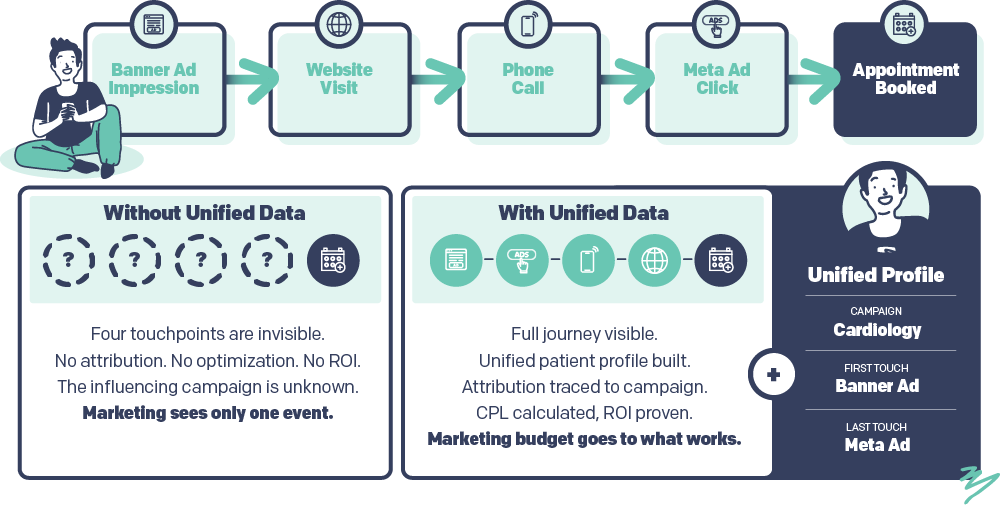
When that data connects, the questions get more aligned to actual ROI. Instead of "how many impressions did we get," you can ask:
- What does it cost to acquire a patient by service line?
- Which campaigns get patients who show up?
- Which referring physicians send the highest-value cases?
- Where are patients choosing a competitor?
Those are the questions that make marketers valuable to finance and clinical leadership. They're also the questions that earn marketing a seat at the executive table.
Patient retention is where this picture gets especially important. Acquiring a new patient is expensive. Health systems lose revenue every day through patients who skip follow-up care, miss specialist referrals, or quietly move to another provider. When your clinical, operational, and marketing data work together, you can identify patients at risk of disengaging and reach them before they leave.
Free Consultation
Still Can't Tie Campaigns to Appointments?
Book a free consultation with our team. We'll map out what it takes to connect your marketing, EHR, and CRM data so you can see what your budget is actually returning.
Learn More →Building a Culture on Data
The technical work is hard. The internal work takes longer.
One of the first moves a new marketing leader can make is a naming one: call the team something related to performance marketing. It sounds simple, but the organization's default assumption is usually that marketing is a cost center. Give it a budget, run some ads, hope for volume. A name change signals that something different is happening before the results show up to back it.
Build the infrastructure before making the pitch to leadership. Trying to sell the vision before the machine exists invites skepticism. Once the tracking is in place, walk into a leadership meeting with one number: what it costs to fill a doctor's open capacity per appointment, and what that patient is worth to the system over the next 12 months. Finance leaders respond to that framing. Most of them have never seen a marketing person think that way, and that number will do more to shift the internal conversation than months of strategy presentations.
Impressions are marketing language. Capacity, cost per acquisition, and revenue per patient mean something to finance and clinical leadership.
When your organization launches a major enterprise data initiative, marketing should get to IT early. Clinical teams often take time to define their use cases. If your marketing team already has use cases mapped and ready to execute, make that case directly: work with us first. We know what we need, we'll move fast, and we'll have results to show while the clinical use cases are still being defined. That's how marketing gets prioritized over teams still figuring out where to start.
If your organization has a data initiative underway right now, make that case before the line gets long.
The Crawl, Walk, Run Roadmap
Getting from "no CRM, no attribution" to a functioning performance marketing engine takes time, but it follows a predictable path.
Crawl: Build the Foundation
Most health systems are crawling. Get HIPAA-compliant infrastructure in place. Connect Epic (or whatever EHR you're using) to your marketing tracking through a tool like Link Source so campaign activity ties to clinical scheduling. Stand up a CRM so patient data has somewhere to live and be acted on.
Also, make sure you define your use cases before building anything. Know what questions you need to answer. The most successful marketing teams we see have their use cases mapped from day one.
Walk: Build the Performance Engine
Funnel visibility comes together in this phase. Campaign activity shows its influence on scheduling as well as appointment adherence. Attribution starts producing answers into what the most successful campaigns are. Then, always-on programs go live to route patients based on actual capacity: urgent care to primary care, ED to primary care, open specialist availability matched to the right audience.
When marketing, scheduling, and CRM data come together on a single patient profile, there's no guessing which campaigns are working.
Run: Optimize and Scale
Patient acquisition runs without manual work. Marketing spend adjusts based on service line capacity. CRM-driven outreach keeps patients in the system through follow-up care, specialist referrals, and care gap outreach triggered by data.
Physician time optimization becomes possible too. We've seen hospitals referring routine blood pressure cases to cardiologists who were already overbooked. Marketing can redirect those cases so cardiologists spend their time with patients who actually need a cardiologist. Getting the right patient to the right physician is the goal.
Quick Wins
Pick one service line, run attribution on it, and put a specific number in front of leadership. That number may be a specific cost per appointment. Find yours. One credible, specific number shifts the conversation fast.
Use your data to redirect budget toward open capacity. If a physician's schedule is full, running campaigns to drive more bookings is brand advertising. Market the open slots. Redirect spend away from physicians who are already booked. Your data tells you exactly which situation you're in.
Start with one physician group. Begin with the groups most willing to participate and the specialties with the most open capacity. Once those groups start seeing patient inquiries come in, other groups notice and ask to join. Start with one, show the before-and-after, and let the results do the persuading.
If there's a data initiative happening in your organization right now, get to IT before the clinical teams define their use cases. Make the case that marketing can execute fast and produce visible results quickly. That's how you get prioritized.
Governance: What Holds the Whole Thing Together
You can do all of the above and watch it fall apart if governance isn't built in from the start. Before any scaling, your organization needs to trust its data foundation. In healthcare, a marketing program built on ungoverned data produces unreliable results and creates legal and reputational exposure that can shut the whole program down.
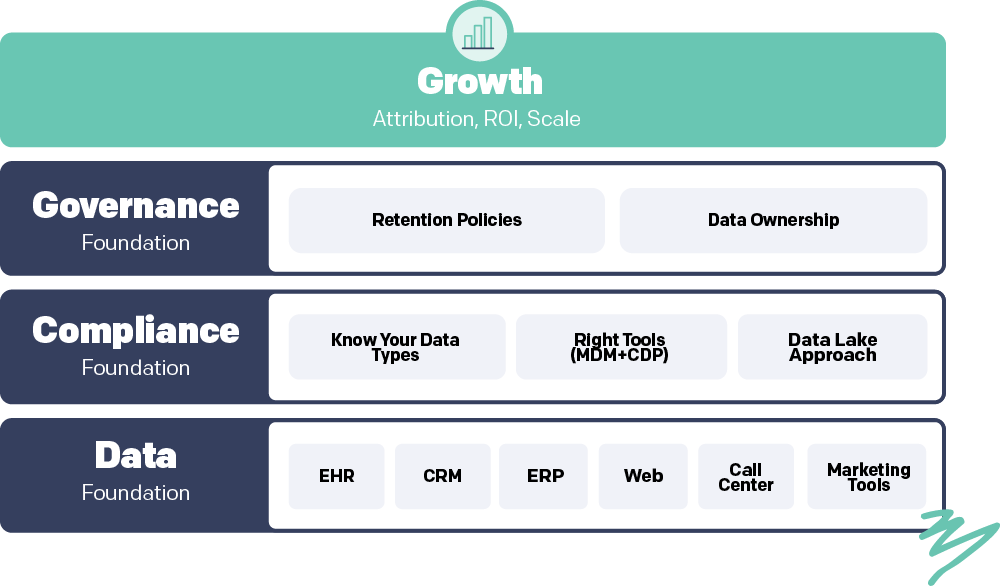
Healthcare data comes in three forms. Structured data like patient demographics, billing records, and medication lists. Unstructured data like clinical notes and imaging. Semi-structured data that sits between them. Most organizations try to govern all three the same way. That's where things break.
Unifying data doesn't mean moving it. A bring-your-own-lake architecture lets you connect your existing infrastructure directly to your marketing and CRM platform and act on data where it already lives.
Before moving out of the crawl phase, your organization should be able to say yes to all of these:
- HIPAA-compliant infrastructure is in place
- Structured, unstructured, and semi-structured data are identified and governed separately
- A master data management layer handles identity resolution
- Data retention policies are compliant
- Marketing, IT, compliance, and clinical leadership agree on who owns what
Getting aligned on that last point is where most organizations stall. Marketing wants the data. IT controls it. Clinical teams protect it. Legal has opinions about all of it. Working through those dynamics in the crawl phase is what lets you move fast.
Health systems that skip governance fail because the foundation wasn't built. It doesn't matter how good your campaigns are.
Where to Start
Healthcare marketing teams fall behind because the systems they rely on were built in silos and never connected.
Start with compliant infrastructure, build through a few well-placed wins, and scale when campaign data, scheduling data, and CRM data are in one place. The health systems that build this foundation now will be operating at a level their peers won't reach for years.