Atlantic Health did it the right way. They're a large non-profit healthcare network in New Jersey with an expansive network of hospitals and outpatient facilities known for amazing cardiovascular and cancer care. They made AI the destination, and a business challenge the starting point. We sat down with Orla Seidel, Director, CRM & Performance Marketing at Atlantic Health, for a webinar called "Empowering Healthcare Teams with Agentforce", and she walked us through how they built their roadmap. They started with a business problem they were facing…they had too many empty colonoscopy slots. Then they built the AI to solve it. Six months later, they had a working use case.
Here's how any hospital or health system can build the same kind of roadmap.
Start With a Problem
The first step is easy. You need to find a problem, and there's probably a ton to choose from.
At Atlantic Health, colonoscopies had a higher cancellation and no-show rate than almost any other same-day procedure. Patients might have skipped the bowel prep, or they ate the wrong thing the night before. They would get confused about which medications to stop and when. So the appointment would be canceled, or the patient showed up and couldn't be treated.
That's a business problem with a dollar value attached. Every canceled slot is lost revenue and wasted staff time. So Atlantic Health picked this as its first AI use case because it hit three goals at once:
- Fewer cancellations
- A better patient experience
- Less time spent on manual outreach
Here's the filter to run every use case through: does it drive revenue, cut costs, or improve the experience?
If the answer is yes, you have a great use case for AI.
Understand Your Data
An AI agent is only as good as the data it's trained on. Before hospital systems launch anything, they should answer a basic question: what do we actually know about this patient, and where does that information live?
If you're like most health systems, the answers are scattered everywhere. Language preferences are stored in one system, while scheduling and clinical data are stored in another. Clinical guidance depends on which physician group you ask.
To navigate that messy data, walk through the same four checkpoints before making an AI investment:
- Data inventory. What systems exist, and what data is in them?
- Hygiene and labeling. Is the data clean (and consistent) enough for an AI to learn from it?
- Secure accessibility. Can you get to the data safely, and can the AI access it the same secure way?
- A governance baseline. Do you have an acceptable use policy?
Skip these steps and your AI process will fall apart the first time a patient asks a question you didn't plan for, or worse, hallucinate a dangerous or misleading response.
Make a Prioritization Matrix
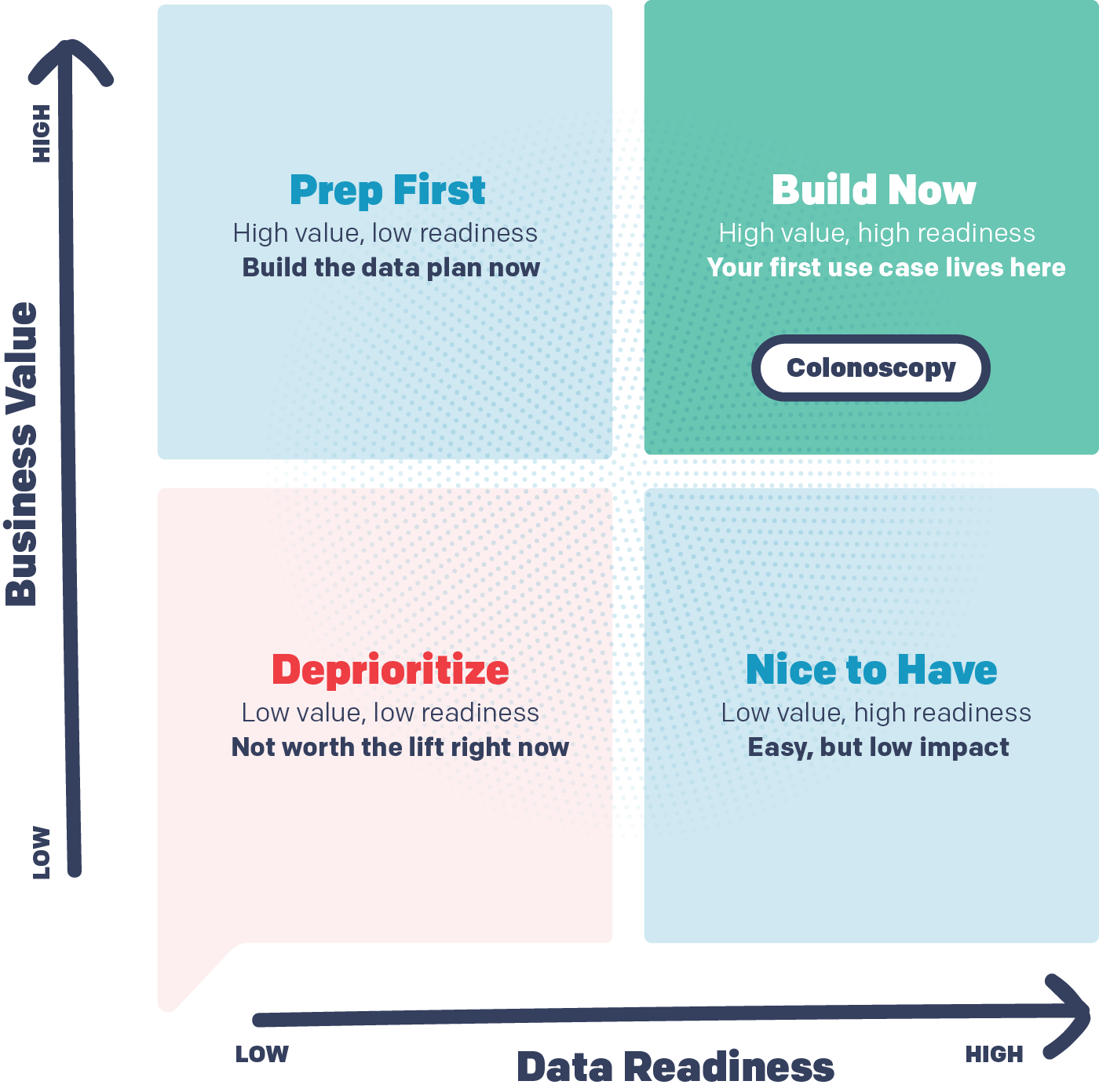
Once you know your data, plot every potential use case on two axes: business value and data readiness. High value and high readiness gets built first. High value and low readiness goes on the roadmap for later, once you've done the work to get the data in shape.
This keeps you from either of the two traps health systems fall into. One is trying to do everything at once, a "big bang" rollout across decades of legacy data that overwhelms every team involved. The other is picking the easiest possible use case regardless of whether it matters to anyone.
Crawl, walk, run. Bring in only the data you need for the use case in front of you. Build the blueprint as you go, so the next use case moves faster.
Set Guardrails Before You Turn Anything On
A general-purpose AI might tell a patient it's fine to take an Uber home after a colonoscopy. In the case of Atlantic Health, their clinical guidance said otherwise.
That's a great example of why an agent can't just pull advice from the open internet. It has to be trained only on your health system's approved knowledge base, and that knowledge base has to be standardized across every physician group and every site. Different clinical teams often have different guidance for the same procedure. Once it's done, a colonoscopy (or any service line you choose) feels the same no matter which location scheduled it.
Build Governance In
You have a problem if your compliance team finds out about your AI project for the first time after it's already built. Legal, IT, and clinical leadership need to be included from the start. Create a cross-functional governance committee before launch, along with a scorecard to evaluate every agent on accuracy, how well it understood patient intent, latency, and overall experience quality.
Governance that shows up after the fact is a blocker.
Pilot With a Path to Production
Pilots that never go anywhere are a waste of everyone's time. Every use case needs a clear path from pilot to full production, or you'll end up stuck in an endless proof-of-concept loop while your organization loses confidence in the whole initiative.
Atlantic Health treated their colonoscopy launch as a pilot with a production plan attached from the start. Once it worked, they had a repeatable process for their next use cases. For many, natural next steps are call routing, scheduling, or referral management.
Use the Feedback Loop
Something many hospitals don't plan for is how much patients will talk to the AI agent. In the case of Atlantic Health's colonoscopy use case, about 20% asked follow-up questions instead of just confirming an appointment. And it wasn't just younger populations. Patients over 65 preferred the voice AI experience to a live phone call, especially for something as sensitive as a colonoscopy.
As Orla Seidel at Atlantic Health put it:
What we found is that patients are actually more willing to talk to an AI agent than they are to a live agent, especially about something that's sensitive about colonoscopy.

Every one of those conversations is now a data point that'll make your AI even better. Patients will mention medications that weren't in their chart, and they'll ask questions the prep materials never answered. Hospital systems can go back and fix the prep materials the next day. AI use cases that start as a way to reduce no-shows can turn into a feedback loop that improves the clinical processes and documentation.
Measure the Lift and Activity Required
Make sure you're measuring the performance of AI processes versus traditional ones. Build in control groups, holdout cells, and no-contact populations, so you can measure the actual lift the AI created, not just the volume of activity around it. That means measuring actual conversions like appointments scheduled and attended.
Also, partner with finance early to figure out the types of conversions worth measuring.
As Orla mentioned, "You have to make sure that you have a close partnership with finance because not all appointments are created equal."
That's because they don't carry the same value, and knowing the contribution margin behind each visit type is what helps you figure out how many dollars or hours you saved with AI.
Make AI the Destination
The starting point should be your use case. Pick one that's rooted in a business challenge. Get honest about the quality of your data, then prioritize by value and readiness. Set guardrails so the agent only speaks from your approved knowledge base. Build governance in from the start. Pilot with a plan to scale. Measure the lift.
Do it in that order, and the AI takes care of itself. Skip a step, and you'll be explaining to your board next year why the chatbot everyone was excited about isn't doing anything.
We've walked health systems through this process from the first data assessment to a live agent talking to patients. If you're trying to figure out how to get AI running, that's a conversation we'd love to have before you buy anything.
Consultation
Find the Right AI Use Case to Start With
We'll help you pick a use case tied to real business impact, check whether your data is ready to support it, and map out what to fix if it's not.
About The Author
With over 15 years of experience in marketing strategy, web development, and creative design, I lead the marketing team at Penrod, a boutique Salesforce partner focused on the healthcare and life sciences industry. As a Salesforce Certified Consultant, I have deep knowledge and skills in leveraging the platform to optimize marketing automation, lead generation, and customer engagement.

Matt Fiel
EVP of Marketing