That doesn’t mean they didn’t drive traffic or even net some booked appointments. But they didn’t give you anything measurable to show the downstream impacts across a patient’s lifetime value. That’s what proves ROI to leadership.
The failure starts in the planning phase. Maybe you didn’t get everyone in marketing, IT, operations, and clinical leadership on board with what the campaign should do and how anyone will know it worked. You’re firmly absorbed in tactics. You send emails, mail postcards, and run retargeting ads, then hope you can correlate enough numbers that will hold up in front of the CFO.
One of the best healthcare marketers I know, Jim Slavo, spearheaded a better approach to service line marketing. Before joining Penrod as our Senior Director of Healthcare Strategy, Jim ran service line campaigns at Franciscan Health that delivered a 39:1 ROI. That’s pretty incredible by any standard, and I sat down with him to pull out everything he did to run a successful service line campaign.
Here’s what we came up with:
Start Above the Data
Jim is a data guy…and he'll tell you campaigns start and stop with data. But he puts strategy, people, and process ahead of it, and one question. Can the service line handle the demand?
I've sadly been a part of helping clients where they're trying to grow things, and we realize that they're growing too quickly, and they can't fill the demand, and it hurts the patient. They end up going somewhere else.

A campaign that outruns your capacity will immediately send patients to a competitor…and you’re wasting time and budget on an audience you can’t even help. Before you build anything to support a service line, answer these questions:
- What problem does this campaign solve?
- Do providers have capacity for new patients?
- How much demand do we need to drive?
- What does success look like to different stakeholders, including leadership?
- Who across the organization needs a voice in the service line campaign?
Marketing is the Glue
Health systems are notoriously siloed, and functions are isolated. IT owns the data, operations runs the schedule and the contact center, and clinical teams own the care.
Who connects them?
Jim believes marketing can be that glue.
Marketing is one of the only departments within a health system that already has a relationship with these groups. So marketing needs to be that driving force. Call it the tip of the spear if you want.
Marketing can show up with the questions and the ideas. The data team learns why the campaign needs certain fields. Clinical leaders see how better targeting and exclusion filters improve the patient experience. The contact center hears about the service line campaign before it launches, so a new promotion doesn't catch agents off guard.
Pick a Service Line You Can Win With
No single service line is the right place to start for everyone, because every health system is different. Jim looks at two things.
- Where does the organization have capacity?
- Where will a campaign bring revenue back into the system?
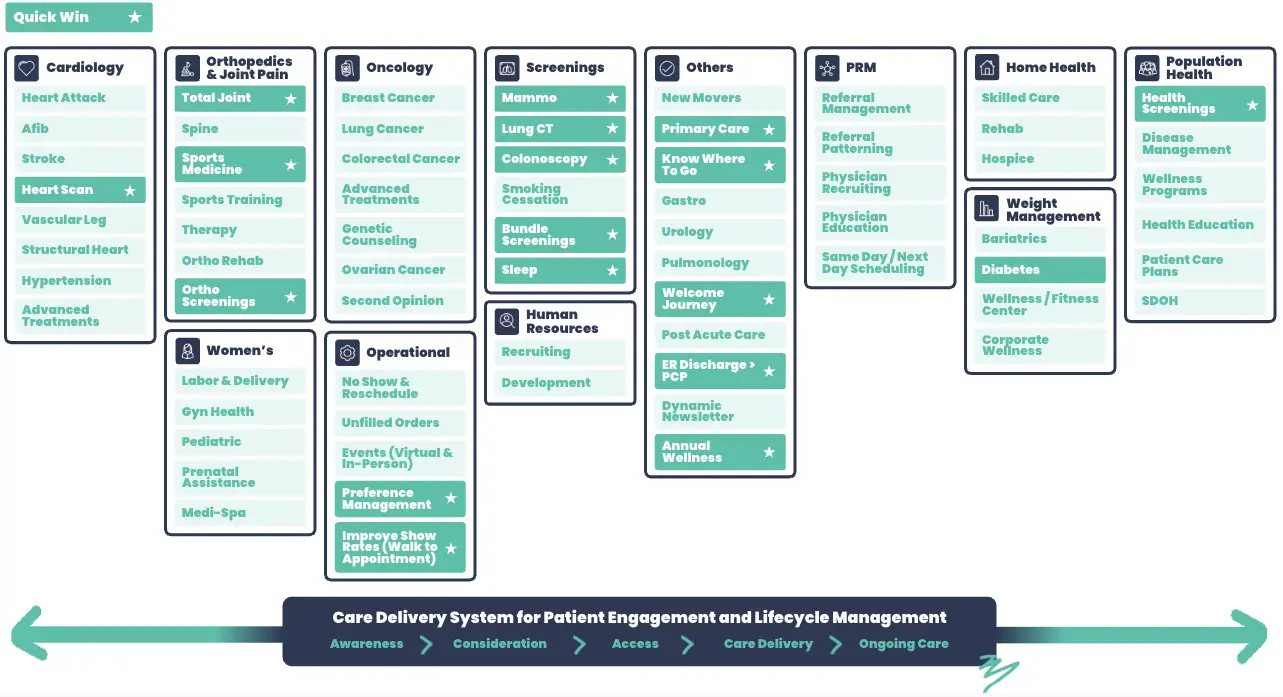
For a first full-funnel campaign, he recommends simple screenings like mammograms and colonoscopies because patients already know them. Then, elective procedures like hip and knee replacements bring in strong revenue (as long as your surgeons have capacity in their schedules).
Keep your first data-driven service line campaign simple because it's a learning exercise. Marketing, IT, creative, performance marketing, and operations are likely all learning how to work together. Don't make them learn on a complex bariatric program with a six-step patient journey.
Here are the service lines and use cases marketing can create campaigns for. Stars mark the quick wins that are the easiest places to start.
Write a Campaign Brief that Teaches
Jim treats campaign briefs as a teaching tool and a plan. It shows each group what the campaign needs, what it will take to execute, and how to measure success. A good brief covers:
- Objective. What the service line campaign needs to accomplish.
- Strategy. The plan, including the patient journey and channel mix.
- Outcomes and supporting goals. The primary number leadership cares about, plus the early signals marketers need to watch along the way.
- Audience. Net new patients, existing patients, or both.
- Data requirements. The clinical, consumer, national, and engagement data the campaign depends on.
- Inclusion and exclusion criteria. Who gets the message (and just as importantly, who shouldn’t).
- Calls to action. Primary, secondary, and tertiary paths for patients at different stages.
- Measurement plan. How you’ll report results…booked appointments and attended appointments.
Get Precise About Who You're Talking To
Jim called the old service line strategies “catcher's mitt marketing.”
"We just kind of send one message to do one thing to just everybody in the database, and we wonder why our engagement rates are so low, and people are opting out. People deserve, and they expect to be talked to one-to-one."
Being precise starts with clinical data from the EHR like demographics, provider and location, encounters, appointments, and care gaps. Payer mix is super important too. If you want more commercially insured patients to balance a large Medicare and Medicaid population, you need to know who carries which coverage.
The EHR only tells you part of the story, though. Someone who isn't getting a service from you might be getting it from a different hospital…and that person isn’t in your EHR. You need to add in third-party consumer data, claims data, social determinants of health, propensity models, and your own engagement data from web visits, form fills, and health risk assessments. Together, they show you larger patient populations as both patients and consumers. The better you know someone, the better your message gets and the more people you can reach.
Exclusion Criteria: The Step Everyone Underestimates
When marketers set up a target audience, the first thing that comes to mind is setting inclusion criteria. But exclusion criteria are equally important because they protect your reputation and help you avoid damaging communications.
Common exclusions include patients who already booked, patients in an active care episode, opt-outs, people who moved out of your market, and anyone your business rules flag as not marketable. Some exclusions need clinical data to work. Jim's mammography example shows why.
"I never, ever want to send a mammography message to someone who's had a double mastectomy. That is just like the worst thing in the world to do, because now it shows them that I don't know you as a patient."
Timing matters too. A patient might book on Monday and cancel on Tuesday. If your exclusion list refreshes once a month, you'll get it wrong and miss out on potential patients.
Exclusion saves money, too. Business rules for emailing existing patients are obvious, but many hospitals waste ad spend on current patients. You can create cookie-based, URL-based, negative keyword lists, or geo-fencing-based suppression audiences for Google Ads, Meta, The Trade Desk, and more...but you have to take great care to ensure compliance. You can’t just upload a list of patients to suppress them from seeing ads. Done correctly, though, you can stop paying to show acquisition ads to people who already see your doctors, and your cost per acquisition drops, plus you get more ad dollars to target net-new patients.
Pick Your Marketing Channels Early
The best marketers pick channels in the strategy phase, even before the audience list exists. Jim starts with first-party data because it brings the lowest cost per acquisition.
- Email still performs when it's personalized and part of a multi-touch plan.
- SMS is, in Jim's words, "absolutely fantastic."
- Google reaches people at the moment of intent, while they're searching.
- Meta drives leads, builds awareness, and opens the door to lookalike audiences (again, you need to do this compliantly).
Keep in mind that, regardless of how impactful they are, paid channels often aren't compliant without the right tactics. In December 2022, the HHS Office for Civil Rights issued guidance on online tracking technologies that treated IP addresses tied to health-related browsing as protected health information. A federal court vacated part of that guidance in 2024. The legal risk stayed, and lawsuits continue.
Many health systems responded by pulling tracking off their sites entirely and lost their attribution data along with it. Others kept going and hoped for the best. Penrod built Destinations to give marketers a better option. It redacts PHI, including IP addresses, before conversion data reaches Google or Meta, so the ad platforms never receive sensitive data. The health system keeps a full record of the first-party data in its customer data platform (CDP). From there, the team builds lookalike audiences and retargeting segments. For more detail on ad platforms, read our guides to Meta ads and HIPAA compliance and Google Analytics HIPAA compliance.
Give Patients an On-Ramp
Not everyone books on the first touch. Someone considering a knee replacement probably needs a month to decide, and that’s why secondary and tertiary calls to action are vital.
The primary CTA is usually scheduling an appointment. A secondary CTA, like a health risk assessment, captures first-party data and moves the person into a nurture journey of emails and texts that answer their questions. A tertiary CTA might be a downloadable guide on what to expect before surgery, or what sets your service line apart from others in the area.
All of the journeys have to tell one story. The ad someone scrolls past on Meta should match the TV spot, the landing page, and the follow-up email. Jim has a message for the creative team here: "You are more important today than ever." A well-written campaign with a consistent look and voice stands out against the health system down the street sending the same message to everyone.
Measure What the CFO Measures
Impressions, clicks, form fills, and scheduled appointments are useful signals, but none necessarily show value to leadership.
According to Jim, "The CFO at a health system needs to understand how much money we actually get on the bottom line for these campaigns. We need to track it all the way down to the actual financial encounter."
Here’s a typical patient funnel and the metrics to measure at each stage.
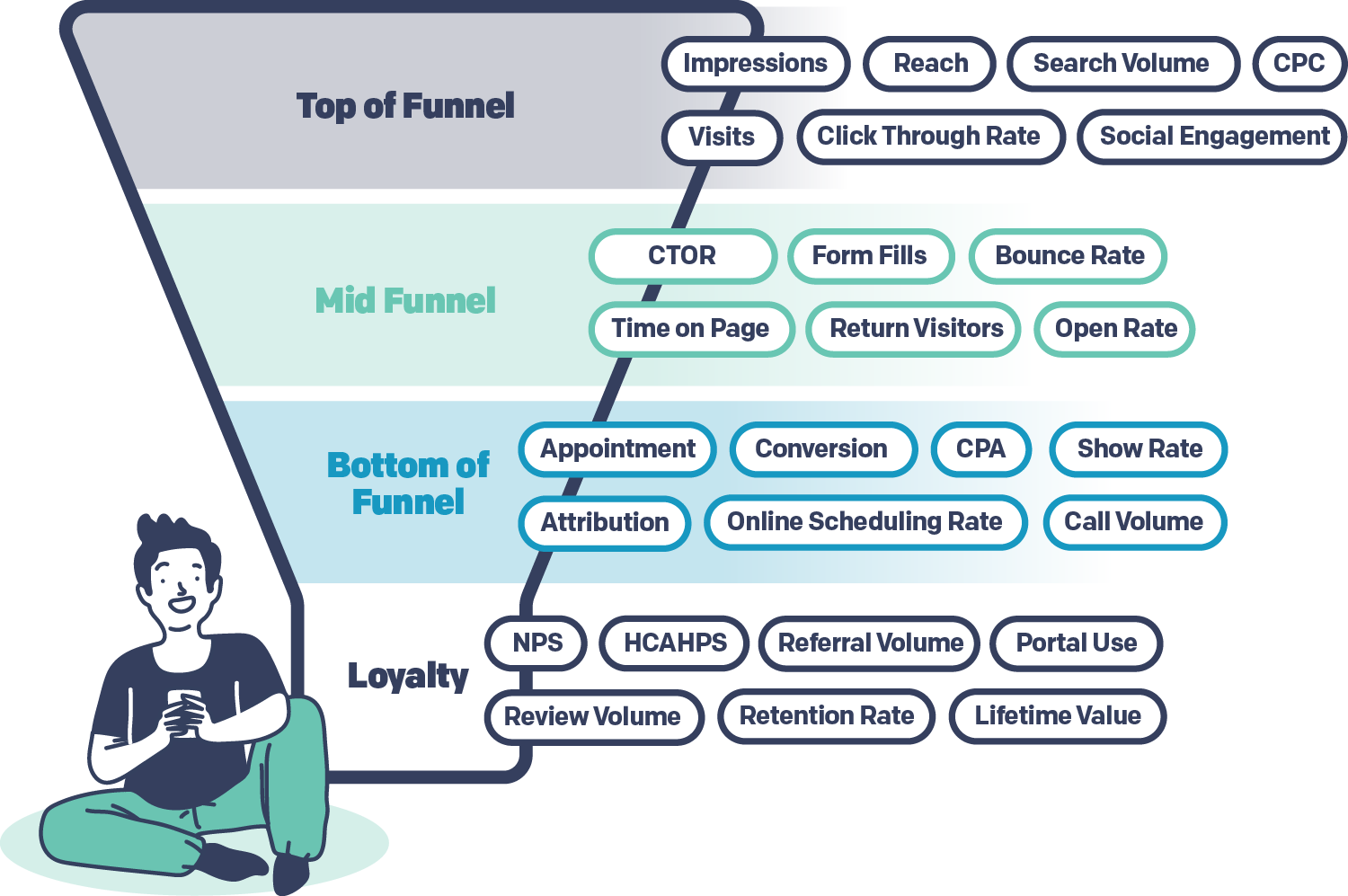
A conversion means the patient showed up for an appointment. In a screening campaign, that means a completed mammogram with its contribution margin attached. Longer journeys have more checkpoints down the patient funnel. For example, a bariatric patient might attend a seminar, then a consult, then finish prerequisites before surgery. Each step is a part of the journey, but the completed procedure is the finish line.
Many teams try to measure this by matching a click on the website's schedule button to a nearby timestamp in the EHR and call it a conversion. But that's not good enough anymore, and you can do better with the right tech stack...conversions have to be directly tied to the campaign and every step of the journey.
When Jim works with health systems, success usually means:
- A bottom-line revenue lift of 3% or more for the campaign.
- A clear count of net new patients and existing patients who are new to the service line.
- Growth in patient lifetime value as patients use more services across the health system.
- Clear lessons on which channels, segments, and geographies drove results, so next year's budget goes toward the right tactics.
Patient lifetime value is usually made up of multiple service line campaigns, and it's how patient acquisition becomes a competitive advantage. A patient who sees your primary care doctor but gets mammograms elsewhere is an opportunity. Bring them into screening, then orthopedics if they ever need a new hip, and the relationship gets stickier with every visit.
The Tech Stack Behind It
You don't need a mystery stack to make this work. Jim's version is pretty practical:
- EHR data, integrated and refreshed in near real time.
- A data warehouse that integrates data from EHR, CDP, finance, and operations.
- A CDP that unifies clinical, claims, consumer, and engagement data. Jim calls it the orchestration engine.
- Email and SMS tools that deliver personalized messages at scale.
- Integrations with Google, Meta, and your other performance platforms.
- A dashboard that keeps important KPIs top of mind.
But Where’s AI?
Have you noticed that we haven’t mentioned AI once? Jim went the whole conversation without it, and as someone who doom scrolls LinkedIn way too much, that was...refreshing. When he finally got there, he was clear about the order of operations.
"If you don't have the data foundation correct, then AI is not going to help you."
Get the data right and agentic tools can run reporting, campaign journeys, contact center messaging, and website bots from one foundation. Skip the data work, and AI will automate your guesses.
Build It Once, Then Repeat
Jim's final test for a successful campaign is whether it is reusable.
He asks, "Did we create a pattern or a system or a process that we can then do in a rinse-and-repeat approach? What did we learn from this, and what did we learn we should never do again?"
You need to do one service line right. Then you can do the next one right, faster. You want to recreate and scale the campaign that drives a 39:1 ROI, not the one built on bad data and unmeasurable outcomes.
Free Consultation
Pick One Service Line. We’ll Help You Win It.
We’ll help you check capacity, map the data you need, and plan how to track results all the way to the financial encounter. You’ll leave with a clear first step and a campaign your CFO can believe in.
About The Author

Matt Fiel
EVP of Marketing